

Markets move fast, and staying ahead requires more than headlines and hype. If you’re searching for clear, actionable insights on market momentum, core finance strategies, and high-yield wealth opportunities, this article is built to give you exactly that. We break down what’s driving today’s financial landscape, how smart budgeting tools can strengthen your foundation, and where investment portfolio insights reveal real potential—not just speculation.
You’ll gain a practical understanding of how to evaluate trends, manage risk, and apply proven asset allocation models to align your portfolio with your financial goals. Every strategy discussed is grounded in disciplined market analysis, time-tested financial principles, and data-backed evaluation of risk and return dynamics.
Whether you’re refining your current approach or building a stronger wealth framework from the ground up, this guide is designed to help you make confident, informed financial decisions in an increasingly complex market environment.
Market swings test every portfolio. The real question: A or B?
Option A is a concentrated portfolio—heavy in one sector, chasing returns. Option B spreads risk across stocks, bonds, cash equivalents, and alternatives. When volatility hits, A can soar or sink dramatically. B bends, not breaks.
This is where asset allocation models matter. They outline how much capital goes into:
- Equities for growth
- Fixed income for stability
- Diversifiers like assets
Diversification—spreading investments to reduce single-point failure—helps balance risk and reward. While critics argue concentration builds faster wealth, history shows balanced portfolios deliver steadier compounding (see Vanguard studies).
Why the Traditional 60/40 Portfolio Is No Longer Enough
For years, investors were told the same thing: put 60% in stocks, 40% in bonds, and relax. The classic 60/40 portfolio was treated like a financial seatbelt—simple, reliable, almost boring. And for a while, it worked.
But here’s the frustration: it hasn’t felt very protective lately.
When both stocks and bonds drop at the same time, that “balanced” portfolio suddenly feels lopsided. In 2022, for example, U.S. stocks and bonds both posted significant losses as inflation surged and the Federal Reserve raised rates aggressively (Federal Reserve, 2022). The supposed hedge failed when investors needed it most.
This is the rise of correlated risk—when assets that used to offset each other start moving in tandem. Inflation shocks, synchronized global economies, and rapid central bank policy shifts have tightened relationships between markets. Traditional asset allocation models assumed bonds would cushion equity declines. Increasingly, that assumption looks shaky.
Some argue diversification still works if you “just stay the course.” Fair. Long-term discipline matters. But ignoring structural shifts in correlation? That’s risky.
A new paradigm focuses on diversifying across economic risk factors—growth, inflation, liquidity—rather than just asset classes. Because real resilience isn’t about owning different labels. It’s about owning exposures that behave differently when it counts.
The Core-Satellite Model: Blending Stability with High-Growth Opportunities
The Core-Satellite Model is exactly what it sounds like. Your core is the steady center of gravity. Your satellites orbit around it, adding targeted power.
Defining Your Core Holding
Your “core” (typically 70–80% of your portfolio) is built from low-cost, broad-market index funds or ETFs. An index fund is a fund designed to track a market benchmark like the S&P 500, rather than trying to beat it. Because it simply mirrors the market, fees stay low (Morningstar consistently shows lower fees improve long-term returns).
Example core components:
- Total Stock Market ETF
- Total International Stock ETF
Together, these create instant diversification—owning thousands of companies across sectors and geographies (think of it as buying the whole buffet, not just one dish).
Some critics argue this approach is “boring” and limits upside. They’re not wrong about excitement. But data from SPIVA reports repeatedly show most active managers underperform their benchmarks over time. Stability wins more often than flash.
Activating Satellite Investments
Your satellites (20–30%) are where you lean into conviction.
These could include:
- Thematic plays like AI or clean energy
- Sector-focused ETFs such as healthcare innovation
- Asset classes like REITs or commodities
Here’s a practical allocation: 75% Core in index funds, 10% in a technology sector ETF, 10% in a real estate investment trust (REIT), and 5% in emerging markets.
What’s next? Rebalance annually. As satellites outperform (or crash), reset back to target weights. Pro tip: Automate contributions to your core first, then deploy satellite capital quarterly. That discipline keeps ambition from overpowering strategy.
The All-Weather Strategy: Engineering a Portfolio for Any Economic Climate
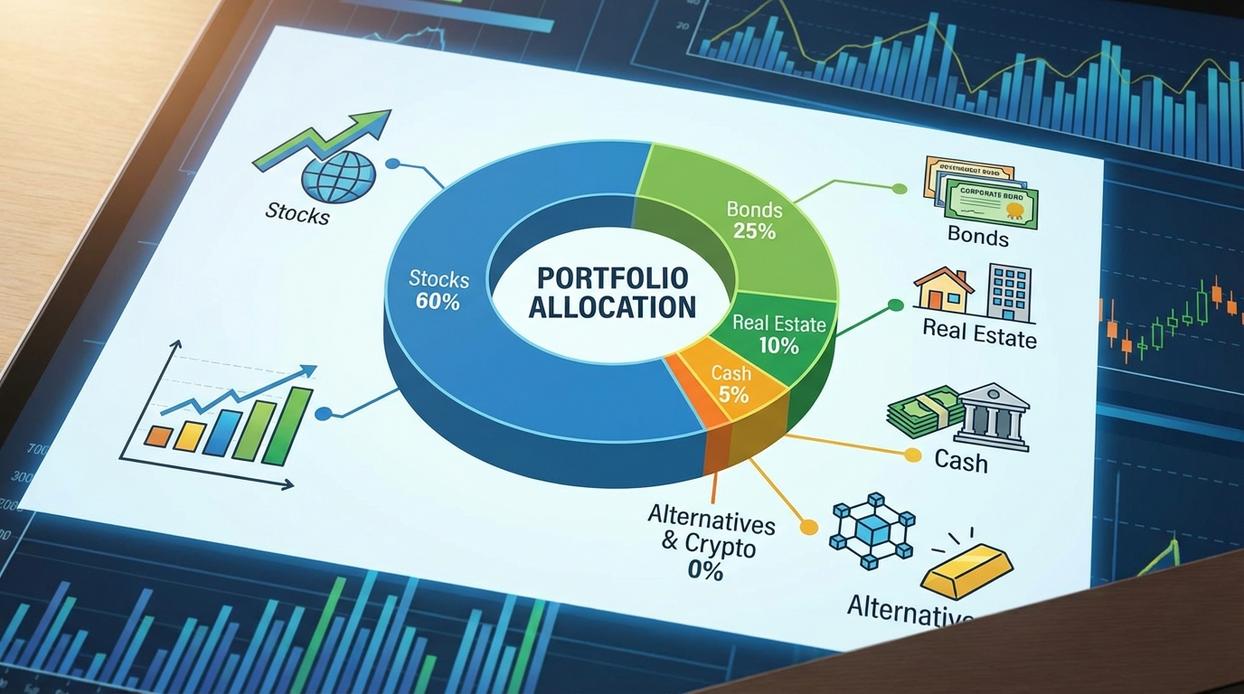
Markets change moods faster than a prestige TV antihero. Boom, bust, inflation spike, deflation scare—each phase rewards different assets. The All-Weather strategy is built on one idea: resilience. Instead of betting on a single outcome, it prepares for all of them.
Compare that to a traditional stock-heavy portfolio. In a roaring bull market, stocks (equities representing company ownership) may soar. But in a recession? That same portfolio can tumble hard. The All-Weather approach smooths those extremes by spreading risk across economic forces.
A classic allocation looks like this: 30% Stocks, 40% Long-Term Treasury Bonds, 15% Intermediate-Term Treasury Bonds, 7.5% Gold, and 7.5% Broad Commodities. Each slice plays defense or offense depending on conditions.
Understanding the Four Quadrants
Think of the economy as four quadrants:
- Rising Growth: Stocks tend to thrive as earnings expand.
- Falling Growth: Long-term Treasury bonds (government debt with longer maturities) often rise as investors seek safety (U.S. Treasuries have historically rallied during downturns; source: Federal Reserve data).
- Rising Inflation: Commodities and gold (a traditional inflation hedge) typically perform better.
- Falling Inflation: Intermediate bonds can stabilize returns as rates adjust.
It’s essentially diversification (spreading investments to reduce risk) taken to a structural level.
A vs. B: Growth Focus vs. Stability Focus
- Growth-heavy portfolio: Higher upside, sharper drawdowns.
- All-Weather portfolio: Lower volatility, steadier compounding.
Critics argue this model caps returns during strong bull markets. That’s fair. But for investors prioritizing capital preservation over bragging rights, smoother performance can mean fewer panic decisions (and better sleep).
Pro tip: disciplined allocation only works if you commit to rebalancing your portfolio when and how to do it.
Smart budgeting is the engine hum beneath your portfolio, the rhythm of dollars moving with purpose. When you track spending with digital tools, you can see surplus cash glowing on the screen, waiting to be redirected toward investments. That discipline makes consistent contributions feel automatic, not forced.
Rebalancing adds structure. Set a schedule—annually or when allocations drift more than 5%—and trim outperformers to buy laggards. It feels counterintuitive (like selling your loudest winner), yet it restores balance.
Tax-efficient placement matters too: keep corporate bonds in tax-advantaged accounts like a 401(k) or IRA, and hold index funds in taxable brokerage accounts.
A Deliberate Path to Long-Term Financial Security
Modern markets—from Wall Street desks in New York to hubs in Austin—reward structure over guesswork. In other words, relying on outdated 60/40 splits alone can leave portfolios exposed when rate cycles shift or liquidity tightens (and they always do). That’s why frameworks like Core-Satellite or All-Weather matter. These asset allocation models balance growth engines with ballast, helping smooth volatility across spikes, recessions, and Fed pivots.
Critics argue diversification dilutes upside. Yet data from Vanguard and Morningstar shows allocation reduces drawdowns over time. So next, audit your weights, flag concentration risk, and rebalance deliberately.
By understanding your risk profile and employing effective asset allocation strategies, you can better align your investments with your financial goals—just as discussed in our article, “Ontpinvest Investing Ideas From Ontpress.
Take Control of Your Financial Momentum
You came here looking for clarity on how to build smarter wealth strategies, strengthen your portfolio, and make informed financial moves with confidence. Now you have a clearer understanding of market momentum, high-yield wealth models, smart budgeting tools, and how asset allocation models create structure in uncertain markets.
The real pain point isn’t a lack of opportunity — it’s uncertainty. Not knowing where to allocate capital. Not knowing if your portfolio is positioned for growth or risk. Not knowing whether your strategy is actually working.
The advantage now is action.
Apply what you’ve learned. Revisit your current allocations. Stress-test your assumptions. Refine your strategy using disciplined asset allocation models and data-backed decision-making instead of guesswork.
If you’re serious about accelerating results, start leveraging proven portfolio frameworks and market insights that consistently help investors optimize returns and reduce downside risk. Don’t let hesitation cost you momentum.
Take the next step today — review your portfolio, implement a smarter allocation strategy, and move forward with a plan built for performance.
 Founder & CEO
There is a specific skill involved in explaining something clearly — one that is completely separate from actually knowing the subject. Jorveth Ollvain has both. They has spent years working with smart budgeting tools in a hands-on capacity, and an equal amount of time figuring out how to translate that experience into writing that people with different backgrounds can actually absorb and use.
Jorveth tends to approach complex subjects — Smart Budgeting Tools, Investment Portfolio Insights, Market Momentum being good examples — by starting with what the reader already knows, then building outward from there rather than dropping them in the deep end. It sounds like a small thing. In practice it makes a significant difference in whether someone finishes the article or abandons it halfway through. They is also good at knowing when to stop — a surprisingly underrated skill. Some writers bury useful information under so many caveats and qualifications that the point disappears. Jorveth knows where the point is and gets there without too many detours.
The practical effect of all this is that people who read Jorveth's work tend to come away actually capable of doing something with it. Not just vaguely informed — actually capable. For a writer working in smart budgeting tools, that is probably the best possible outcome, and it's the standard Jorveth holds they's own work to.
Founder & CEO
There is a specific skill involved in explaining something clearly — one that is completely separate from actually knowing the subject. Jorveth Ollvain has both. They has spent years working with smart budgeting tools in a hands-on capacity, and an equal amount of time figuring out how to translate that experience into writing that people with different backgrounds can actually absorb and use.
Jorveth tends to approach complex subjects — Smart Budgeting Tools, Investment Portfolio Insights, Market Momentum being good examples — by starting with what the reader already knows, then building outward from there rather than dropping them in the deep end. It sounds like a small thing. In practice it makes a significant difference in whether someone finishes the article or abandons it halfway through. They is also good at knowing when to stop — a surprisingly underrated skill. Some writers bury useful information under so many caveats and qualifications that the point disappears. Jorveth knows where the point is and gets there without too many detours.
The practical effect of all this is that people who read Jorveth's work tend to come away actually capable of doing something with it. Not just vaguely informed — actually capable. For a writer working in smart budgeting tools, that is probably the best possible outcome, and it's the standard Jorveth holds they's own work to.