Building lasting wealth isn’t about chasing every hot stock or timing the market perfectly. It’s about understanding what actually drives sustainable financial growth—and using that knowledge to make smarter decisions over time. If you’re searching for clear, actionable insights on market momentum, core finance strategies, and high-yield wealth models, this article is designed to give you exactly that.
We break down the principles that separate consistent investors from those who struggle with volatility and uncertainty. From smarter budgeting frameworks to portfolio positioning techniques, you’ll learn how to align your financial moves with long-term objectives instead of short-term noise.
At the center of it all is the power of compounding returns—a principle backed by decades of market data and real-world performance analysis. Our insights are grounded in careful research, historical trend evaluation, and practical financial modeling to ensure you’re not just informed, but equipped to act confidently.
If your goal is clearer strategy, stronger returns, and better control over your financial future, you’re in the right place.
From Acorns to Oak Trees: The Real Secret to Investment Growth
Most investors obsess over Stock A vs. Stock B. Growth stock or dividend play? Hot tech or steady utilities? That debate misses the bigger engine: the power of compounding returns.
Think of it like planting an acorn. Option A: chase the “next big thing” each year. Option B: consistently reinvest gains and let time do the heavy lifting. History favors B. According to Vanguard, long-term equity investors benefit most from disciplined reinvestment and time in the market.
- Small, steady contributions often outperform sporadic big bets.
It’s less “Wolf of Wall Street,” more slow-burn strategy (boring, but effective).
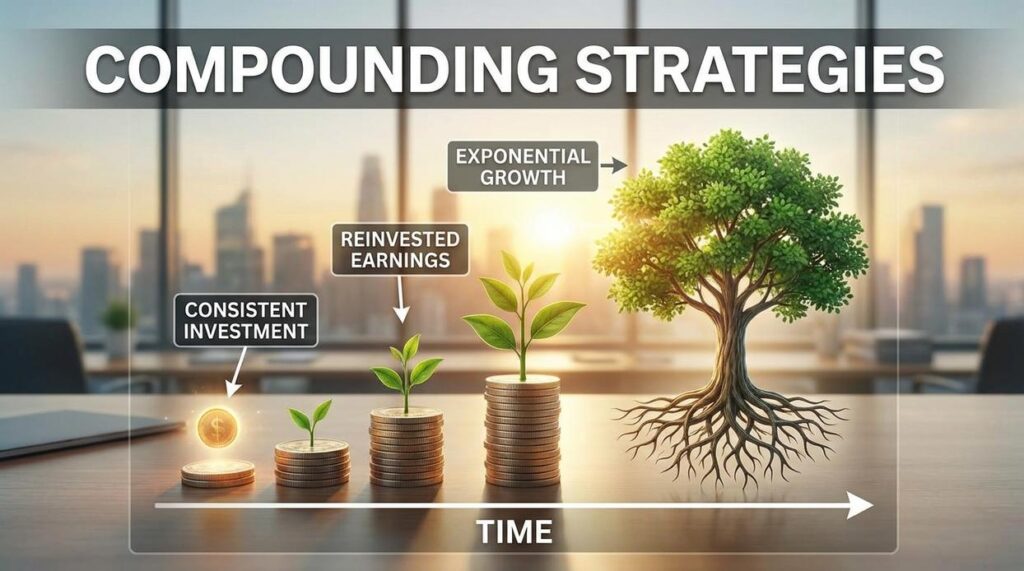
Unpacking the ‘Snowball Effect’: How Compounding Actually Works
Let’s clear up a common confusion. Compounding simply means earning returns on your returns. In other words, your money makes money—and then that new money starts making money too. By contrast, simple interest only pays returns on the original principal (the starting amount), not on any accumulated gains.
Here’s a practical example.
Start with $10,000 invested at an 8% annual return.
- Year 1: 8% of $10,000 = $800 profit. Total: $10,800.
- Year 2: 8% of $10,800 = $864 profit. Total: $11,664.
- Year 3: 8% of $11,664 = $933.12 profit. Total: $12,597.12.
Notice what’s happening? The rate stays the same, but the dollar gains grow each year. That accelerating growth is the power of compounding returns in action.
Because of this snowball effect, compounding is often called the “eighth wonder of the world,” a phrase commonly attributed to Albert Einstein (though historians debate the source). The idea is simple: time turns steady returns into exponential growth.
So while compounding isn’t a flashy strategy, it is a fundamental law of wealth creation. The earlier you start, the bigger the snowball becomes.
The Three Levers That Supercharge Your Returns
To truly harness the power of compounding in your high-return portfolio, it’s essential to not only understand the investment strategies involved but also to consider the costs associated with obtaining professional financial advice, as highlighted in our article ‘How Much Should Financial Advice Cost on Pinvest’ – for more details, check out our How Much Should Financial Advice Cost Ontpinvest.
Most investors ask the same question: How do I actually grow my money faster? The answer comes down to three controllable levers.
Lever 1: Time – The Great Multiplier
Time is the most powerful force in investing. Why? Because returns build on previous returns. That’s the power of compounding returns in action.
Consider this example:
- Investor A starts at 25, investing $6,000 per year until 65 at 8%.
- Investor B starts at 35, investing the same $6,000 per year at 8%.
By 65, Investor A ends with roughly $1.68 million, while Investor B has about $745,000 (based on compound interest calculations). Same contribution. Same return. A 10-year head start creates nearly double the outcome.
Some argue you can “catch up later” by investing more aggressively. While higher contributions help, lost time is nearly impossible to recover fully. (Think of it like showing up late to a snowball fight—the biggest snowballs are already rolling.)
Lever 2: Rate of Return – The Engine’s Power
A small return difference matters more than most realize.
- $500/month for 30 years at 6% ≈ $502,000
- $500/month for 30 years at 9% ≈ $818,000
That 3% gap adds over $300,000.
This is where smart asset allocation comes in. However, chasing high returns blindly can backfire. Before stretching for yield, review understanding high yield investment models and their risks.
Lever 3: Consistent Contributions – The Fuel
Compounding works on the entire balance. Every $500 monthly deposit increases the base that earns returns next year.
Pro tip: Automate contributions so consistency becomes effortless.
Time multiplies. Returns accelerate. Contributions expand the base.
Master all three, and your portfolio doesn’t just grow—it compounds with purpose.
Actionable Ways to Put Compounding to Work in Your Portfolio

Compounding is simple to define: it’s earning returns on your returns. Over time, those reinvested gains create a snowball effect (yes, the boring kind that quietly becomes massive). Here’s how to actually use it.
1) Automate with Dividend Reinvestment Plans (DRIPs)
A Dividend Reinvestment Plan (DRIP) automatically uses your cash dividends to buy more shares of the same investment. Instead of pocketing $100 in dividends, your brokerage buys additional fractional shares—no effort required.
How to do it:
• Log into your brokerage account.
• Select “Dividend Reinvestment” for eligible holdings.
• Confirm automatic reinvestment.
Real-world example: If you own an ETF yielding 2% annually, those payouts buy more shares, which generate more dividends next year. That’s the power of compounding returns in action.
2) Leverage Tax-Advantaged Accounts
Tax drag (taxes reducing investment growth) slows compounding. Accounts like a 401(k) (tax-deferred) or Roth IRA (tax-free withdrawals) act as compounding accelerators.
Step-by-step:
- Contribute consistently (aim for employer match first).
- Invest contributions, don’t leave them in cash.
- Reinvest all distributions.
Pro tip: Even a 1% annual fee difference can significantly reduce long-term returns (SEC.gov).
3) Focus on Broad Market Index Funds
An index fund tracks a market benchmark like the S&P 500. Instead of betting on one stock (the “next big thing”), you own hundreds at once.
Example: Historically, the S&P 500 has averaged about 10% annually before inflation (S&P Global). Low-cost ETFs let you capture that growth while minimizing fees.
Keep it automated. Keep it diversified. Then let time do the heavy lifting.
Time can feel invisible, like a quiet clock ticking in the background of your life. Yet when you understand the blueprint of smart investing, you begin to hear that ticking differently. You now know the difference between simply saving and strategically investing: one grows in a straight, predictable line, while the other curves upward, almost breathtaking in its momentum.
In other words, linear growth preserves; exponential growth transforms. That transformation is driven by the power of compounding returns, a force that builds subtly at first, then accelerates like a rising tide.
Some argue investing is too risky and that steady saving is safer. And yes, safety has its place. However, history shows disciplined, long-term investing in diversified markets has consistently outpaced inflation (S&P 500 historical average returns, 1926–2023).
So now, take action. Review your portfolio. Automate contributions. Let patience and consistency turn today’s small steps into tomorrow’s financial freedom secure.
Take Control of Your Financial Momentum
You came here looking for clarity on how to build sustainable wealth, strengthen your strategy, and make smarter financial moves. Now you understand how market momentum, disciplined budgeting, and high-yield allocation models work together to create lasting results.
The biggest frustration for most investors isn’t lack of effort — it’s uncertainty. Not knowing where to focus. Not knowing if your strategy is truly optimized. And most importantly, not fully leveraging the power of compounding returns over time.
The good news? You now have the framework to fix that.
Start by tightening your budgeting system, reallocating toward higher-performing assets, and reviewing your portfolio with a momentum-focused lens. Small, strategic adjustments today can unlock exponential growth tomorrow.
If you’re serious about accelerating your wealth-building strategy, now is the time to act. Apply these principles immediately, track your performance consistently, and refine your allocations with proven, data-driven methods. Thousands of investors rely on structured financial frameworks to eliminate guesswork and maximize returns — you should too.
Take action today, implement what you’ve learned, and put the power of compounding returns to work for you.
 Wealth & Investment Analyst
Lisa Timberlakeresty is the kind of writer who genuinely cannot publish something without checking it twice. Maybe three times. They came to core finance strategies through years of hands-on work rather than theory, which means the things they writes about — Core Finance Strategies, Expert Breakdowns, High-Yield Wealth Models, among other areas — are things they has actually tested, questioned, and revised opinions on more than once.
That shows in the work. Lisa's pieces tend to go a level deeper than most. Not in a way that becomes unreadable, but in a way that makes you realize you'd been missing something important. They has a habit of finding the detail that everybody else glosses over and making it the center of the story — which sounds simple, but takes a rare combination of curiosity and patience to pull off consistently. The writing never feels rushed. It feels like someone who sat with the subject long enough to actually understand it.
Outside of specific topics, what Lisa cares about most is whether the reader walks away with something useful. Not impressed. Not entertained. Useful. That's a harder bar to clear than it sounds, and they clears it more often than not — which is why readers tend to remember Lisa's articles long after they've forgotten the headline.
Wealth & Investment Analyst
Lisa Timberlakeresty is the kind of writer who genuinely cannot publish something without checking it twice. Maybe three times. They came to core finance strategies through years of hands-on work rather than theory, which means the things they writes about — Core Finance Strategies, Expert Breakdowns, High-Yield Wealth Models, among other areas — are things they has actually tested, questioned, and revised opinions on more than once.
That shows in the work. Lisa's pieces tend to go a level deeper than most. Not in a way that becomes unreadable, but in a way that makes you realize you'd been missing something important. They has a habit of finding the detail that everybody else glosses over and making it the center of the story — which sounds simple, but takes a rare combination of curiosity and patience to pull off consistently. The writing never feels rushed. It feels like someone who sat with the subject long enough to actually understand it.
Outside of specific topics, what Lisa cares about most is whether the reader walks away with something useful. Not impressed. Not entertained. Useful. That's a harder bar to clear than it sounds, and they clears it more often than not — which is why readers tend to remember Lisa's articles long after they've forgotten the headline.