Markets are shifting faster than ever, and investors searching for reliable ways to grow and protect their wealth need clarity—not noise. This article is designed to break down current market momentum, core financial principles, high-yield wealth models, and portfolio diversification strategies that actually work in today’s environment. Whether you’re refining your long-term investment approach or looking to optimize short-term gains, you’ll find practical insights grounded in real data and time-tested financial frameworks.
We analyze market trends, capital flows, and performance metrics across multiple asset classes to ensure every recommendation is rooted in evidence—not speculation. By combining disciplined budgeting tools with strategic portfolio structuring, this guide helps you align your investments with measurable financial goals.
If your goal is smarter allocation, stronger risk management, and sustainable wealth growth, the insights ahead will give you a clear, actionable roadmap built on proven financial analysis and strategic investment expertise.
Beyond Stocks and Bonds: Building a Resilient Portfolio for Today’s Market
Market volatility doesn’t just rattle nerves; it erodes wealth. For decades, a simple 60/40 stock-bond split was considered prudent. However, inflation, geopolitical shocks, and synchronized downturns have weakened that shield (see IMF volatility reports, 2023). So what now?
This guide outlines practical portfolio diversification strategies that extend beyond traditional allocations. Think real assets like commodities and REITs, alternative income streams such as private credit, and cash management.
Critics argue alternatives add complexity and fees. Fair point. Yet ignoring uncorrelated assets leaves portfolios exposed when equities and bonds fall together.
The Pillars of Diversification: Understanding Asset Correlation
True diversification isn’t about owning a lot of investments. It’s about owning investments that behave differently when markets shift. This difference in movement is called asset correlation—a measure of how assets move in relation to one another. Low correlation means they don’t move in sync. And that’s where the magic happens.
The primary asset classes form the backbone of smart portfolios:
- Equities (Stocks): Ownership in companies, offering growth potential but higher volatility.
- Fixed Income (Bonds): Loans to governments or corporations, typically steadier and income-focused.
- Real Assets: Investments like real estate and commodities that often hedge against inflation.
- Alternatives: Assets such as private equity or hedge funds that follow different return patterns.
Here’s why this matters. During a recession, stocks may fall as earnings shrink. Bonds, however, often rise as investors seek safety (think of it as financial musical chairs). That non-correlation cushions overall losses.
The primary goal is reducing unsystematic risk—risk tied to a single company or sector—without lowering long-term return potential. That’s the real benefit of portfolio diversification strategies: smoother performance, fewer sleepless nights, and stronger resilience when markets test your patience.
And resilience, in investing, compounds.
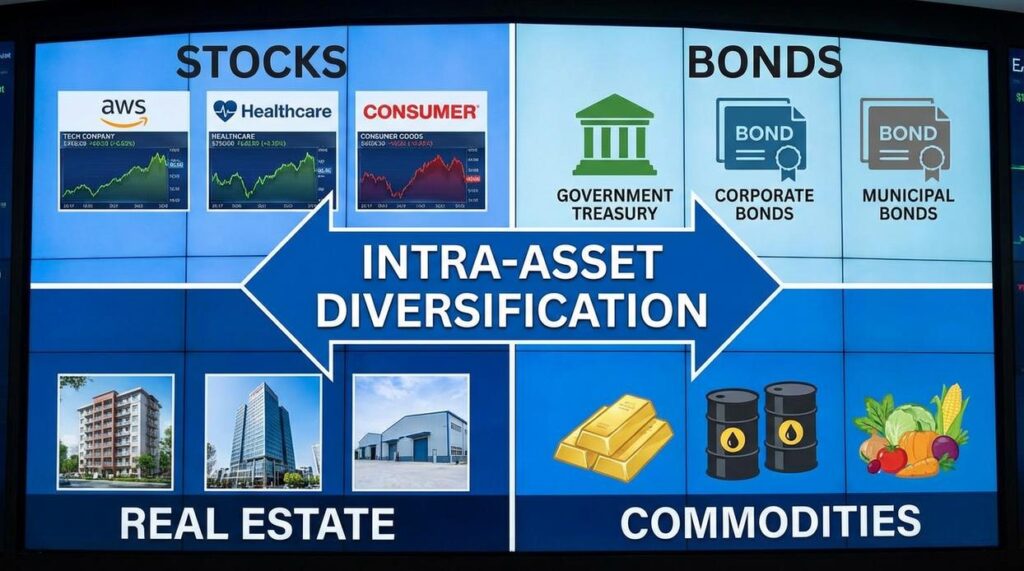
Method 1: Diversifying Within Asset Classes

Diversification doesn’t stop at “own stocks and bonds.” Real resilience comes from spreading risk inside each bucket. Think of it as upgrading from a single-lock door to a full security system (Ocean’s Eleven style, but legal).
Equities Deep Dive
Within stocks, diversify by market capitalization—the total value of a company’s shares. Large-cap companies (like Apple) tend to be stable, mid-caps balance growth and risk, and small-caps can deliver outsized gains (with bumpier rides). Back in 2020, small-cap stocks rebounded sharply after the pandemic selloff, reminding investors how leadership can rotate quickly (Source: Russell Index data).
Geography matters too. Domestic stocks may feel familiar, but international and emerging markets add exposure to different economic cycles. Finally, diversify by sector—technology, healthcare, industrials, and more—so one slowdown doesn’t derail your entire allocation.
Fixed Income Strategy
Bonds deserve equal precision. Duration measures sensitivity to interest rates; short-term bonds fluctuate less, while long-term bonds swing more when rates change. In 2022, long-duration bonds fell sharply as rates rose (Source: Bloomberg U.S. Aggregate Bond Index).
Credit quality also counts. Government bonds are typically safer, while corporate high-yield bonds offer more return with higher default risk. Add variety with TIPS (Treasury Inflation-Protected Securities), designed to hedge inflation.
Actionable Tip: Broad-market ETFs like VTI (total U.S. stock market) or BND (total bond market) provide instant internal diversification.
Some argue that owning a few strong companies is enough. But history shows concentrated bets magnify losses. Smart portfolio diversification strategies help smooth volatility over time. For a broader framework, review asset allocation strategies for different risk profiles. (Pro tip: Rebalance annually to maintain your targets.)
Method 2: Expanding into Alternative and Real Assets
If your portfolio only holds stocks and bonds, you’re essentially betting on public markets alone. Expanding into alternative and real assets adds new return streams that don’t always move in sync with Wall Street (and that independence can be powerful).
Harnessing Real Estate
Real estate is one of the most accessible real assets. You can buy property directly—like a rental home generating monthly income—or invest through a Real Estate Investment Trust (REIT), a company that owns income-producing properties and trades like a stock. REITs offer liquidity and built-in diversification across offices, apartments, or warehouses.
For example, instead of saving years for a down payment, you could allocate 5–10% of your portfolio to a diversified REIT ETF. Historically, REITs have provided competitive long-term returns and income through dividends (Nareit, 2023). Pro tip: focus on sectors with durable demand, such as industrial or healthcare properties.
The Role of Commodities
Commodities—raw materials like gold or oil—often act as an inflation hedge. An inflation hedge is an asset designed to maintain purchasing power when prices rise. Gold, for instance, has historically performed well during periods of high inflation and currency weakness (World Gold Council, 2022).
Practically speaking, you can gain exposure through commodity ETFs without storing physical bars of gold (unless you’re going for a pirate aesthetic).
Exploring Alternatives
Finally, consider private credit or infrastructure funds. Private credit involves lending directly to companies outside traditional banks, often offering higher yields. Infrastructure funds invest in essential assets like toll roads or energy grids—services people rely on regardless of market cycles.
Together, these tools strengthen portfolio diversification strategies by reducing reliance on traditional public markets while broadening potential return sources.
Method 3: Strategic Implementation and Portfolio Maintenance
Rebalancing is the disciplined process of selling assets that have grown and buying those that have shrunk to return to your target allocation. In simple terms, it’s a RESET button for your portfolio. If stocks surge and now make up 80% instead of your planned 70%, you trim them back. If bonds lag, you add to them. This keeps risk aligned with your goals—not your emotions.
Set a clear schedule to avoid impulse decisions:
- Rebalance annually, or
- When any asset class drifts more than 5% from its target.
Your TIME HORIZON matters. A 25-year-old investor can typically hold a more aggressive mix because time helps smooth volatility (think of it as riding out the waves). Someone nearing retirement may prefer stability and income-focused assets.
Finally, consistent contributions enable dollar-cost averaging—investing fixed amounts regularly regardless of price. Combined with portfolio diversification strategies, this builds discipline and long-term resilience.
You’ve now seen how effective diversification works across asset classes, geographies, and sectors. In other words, real stability comes from layers, not luck. Yet many investors still cling to concentrated portfolios, assuming conviction alone will protect them. It won’t. A single shock—like the 2008 financial crisis or the 2020 pandemic selloff—can quickly expose that weakness. Instead, apply disciplined portfolio diversification strategies to spread risk intentionally. Start by reviewing your current holdings and identifying gaps in sector or geographic exposure. Then, rebalance with purpose, prioritizing resilience alongside growth. Take that first step today and build a stronger, steadier financial future now.
Take Control of Your Financial Momentum Today
You came here looking for clarity on how to build smarter wealth systems, strengthen your financial foundation, and make more confident investment decisions. Now you have a clearer roadmap—one that connects market momentum, disciplined budgeting, high-yield wealth models, and portfolio diversification strategies into a practical plan of action.
The real pain point isn’t lack of opportunity—it’s uncertainty. Not knowing where to allocate capital. Not knowing if your portfolio is balanced enough. Not knowing whether your current strategy can withstand volatility. That uncertainty is what holds most people back.
The solution is consistent, informed action. When you apply structured financial planning, monitor market signals, and refine your allocation strategy, you move from reacting to markets to positioning yourself ahead of them.
Now it’s time to act. Use proven frameworks, leverage smart budgeting tools, and implement disciplined diversification strategies that reduce risk while maximizing upside potential. Join thousands of investors who rely on top-rated financial insights to sharpen their edge. Start optimizing your portfolio today and turn financial complexity into confident, strategic growth.